




Your AI feature launched to applause. Usage is climbing, the demo wows prospects, and the roadmap is full. Then finance asks one simple question at the end of the quarter: what does this actually cost us to run, per customer? The room goes quiet.
This is the AI margin trap. You bill customers a flat subscription, measured in MRR. You pay your model provider by the token, measured in usage. Those two lines do not move together, and the gap between them is your AI gross margin, quietly leaking away.
Why AI breaks the classic SaaS margin math
Traditional SaaS has beautiful economics. The marginal cost of one more user is close to zero. You build the software once, and every new seat is almost pure margin.
AI features do not work that way. Every request carries a real, variable cost: input tokens, output tokens, context length, retries, and sometimes GPU time. A power user who sends long prompts all day can cost ten times more than a light user on the same plan, while both pay the same MRR.
So your most engaged customers, the ones you celebrate in QBRs, can be your least profitable. You will not see it in aggregate revenue. You only see it when you divide cost by customer.
The trap is invisible until you measure per customer
Most teams watch total spend. The monthly model bill goes up, someone notes that “AI costs are growing,” and it gets filed under the cost of doing business.
Total spend hides the real problem. What matters is the shape of the distribution:
- cost per 1,000 requests, trending over time
- token consumption by model and by feature
- cost per tenant, and your top tenants by spend
- cost as a percentage of that tenant’s MRR
The moment you put cost next to revenue at the account level, the trap becomes obvious. A handful of tenants usually consume a disproportionate share of tokens, and some of them may be paying you less than they cost to serve.
How token costs erode AI gross margin
Margin erosion in AI rarely arrives as one big event. It creeps in through small, compounding changes:
- Prompt bloat. Context windows grow as engineers add examples and history. Every extra token ships on every call.
- Model upgrades. A more capable model improves quality and quietly raises cost per request.
- Retries and fallbacks. Reliability logic reruns expensive calls that never appear in a feature spec.
- Usage growth on flat plans. Adoption climbs, MRR stays flat, tokens keep rising.
None of these is wrong on its own. Together, without visibility, they can turn a healthy feature into a loss leader you never chose to run.
What margin-safe AI monitoring looks like
Protecting margin does not mean shipping worse AI. It means watching cost and revenue in the same view, the way FinOps teams already watch cloud spend. The signals that matter:
- Cost per 1K requests and cost per tenant, refreshed daily, not discovered at invoice time.
- Token consumption by model and feature, so you know where the spend actually goes.
- Cost against MRR per account, so unprofitable tenants surface early.
- Latency, error rate, and quality alongside cost, so you never cut spend in a way that breaks the product.
With that in place, the expensive questions get easy answers. Which feature is dragging margin? Which tenant needs a usage-based plan? Did last week’s model change pay for itself? Where is prompt bloat hiding?
From cost surprise to unit economics you control
The goal is to stop being surprised. When token cost and MRR sit side by side, you can act before margin turns negative.
- See it. Cost per request, per model, and per tenant, updated on a schedule.
- Attribute it. Tie spend to the features and accounts driving it.
- Decide. Repackage heavy users, trim prompts, and route cheaper models where quality allows.
- Protect it. Watch quality and reliability so cost control never degrades the experience.
That is the difference between an AI feature that scales revenue and one that scales your model bill faster than your MRR.
Close the gap between tokens and revenue
The AI margin trap is not caused by expensive models. It is caused by flying blind: charging in MRR while paying in tokens, and never putting the two numbers in the same place.
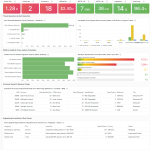
Awishcar’s AI Product Monitoring dashboard brings LLMOps, FinOps, and reliability into one view: daily spend, cost per 1,000 requests, token consumption, and top tenants by spend, right next to latency, errors, and quality. It is part of our Operational Intelligence Dashboards.
If you want to see your real cost per customer before finance asks, book a free walkthrough.
Related reading
Margin is one silent killer. Churn is the other. See The Silent Churn Killer (CRM + DB) for how retention risk hides in the gap between your CRM and your database.
Featured photo via Unsplash.