



Most SaaS teams find out about churn too late. The renewal call goes quiet, an invoice goes unpaid, and a “healthy” account quietly disappears. Everyone is surprised, because the account was green in the CRM last week.
Here is the uncomfortable truth: the account was never healthy. The customer churn signals were sitting in your database the whole time, and nobody was reading them next to the CRM.
That gap, between what your CRM says and what your data actually knows, is the silent churn killer.
Why your CRM lies about churn
CRM health scores feel authoritative. They are colored red, yellow, and green, and they roll straight into board decks. But most of them are built on lagging, human-entered inputs:
- last contacted date
- a CSM’s gut-feel health rating
- stage in the renewal pipeline
- notes from the last business review
These fields describe how the relationship feels, not how the product is being used. A CSM marks an account green because the last call went well. Meanwhile, logins have dropped 40 percent, the power user has left, and three support tickets are open. The CRM has no idea.
By the time a human updates the CRM, the churn decision has often already been made inside the customer’s organization.
Where the real customer churn signals live
Your product database and warehouse hold the leading indicators. They are quieter than a sales note, but they are earlier and far harder to fake:
- weekly active users trending down
- key feature adoption stalling
- session length and frequency decaying
- API errors or failed jobs climbing
- support ticket volume and severity spiking
- payment failures and downgrades in billing
Each of these is a small signal. On its own, none of them trips an alarm. Together, and tracked over time, they form a pattern that appears weeks before a renewal is at risk.
This is the part most teams miss. The data already exists. It is just scattered across Stripe, Postgres, your warehouse, product analytics, and Zendesk, and it never gets joined back to the account record in the CRM.
The silent killer is the join, not the data
Here is the core problem. Your CRM knows who the account is. Your database knows what the account does. Almost no one connects the two.
So RevOps watches pipeline health, engineering watches usage and errors, and finance watches billing. Each team sees one instrument, and no one sees the whole cockpit.
Churn thrives in that gap. A silent decline in usage never reaches the person who owns the renewal, because the two systems do not talk to each other.
Closing that gap does not require a machine learning moonshot. It requires joining CRM context (owner, plan, segment, renewal date, ARR) with database behavior (usage, errors, support, payments), and scoring the result.
What CRM plus database churn intelligence looks like
When you unify the two, the picture changes quickly. Instead of a subjective health color, you get:
- ARR at risk, quantified. A model-driven number, not a vibe.
- Risk bands per account. Red and yellow, tied to real behavior.
- Driver analytics. Not just that risk went up, but why: usage drop, inactivity, payment failure, or support spike.
- Renewal exposure. Which dollars are up for renewal by segment and plan, and how many are at risk.
The value is not only prediction. It is explainability. A CSM will not act on a black-box score. They will act on “this account’s logins fell 45 percent and their champion stopped logging in three weeks ago.”
That is the difference between a dashboard people ignore and one that changes what the team does on Monday.
From signal to action
The point of catching churn early is time: weeks of warning instead of days. With CRM and database signals joined, a retention motion becomes concrete.
- Detect. Risk scores refresh on a daily or weekly schedule.
- Prioritize. CS time goes to the highest ARR at the highest risk, not the loudest customer.
- Explain. Every at-risk account arrives with its top drivers attached.
- Intervene. The play matches the driver. An adoption gap gets enablement, a payment failure gets billing, a support spike gets an escalation.
Do this consistently and the outcomes compound: earlier detection, fewer surprise losses, higher net revenue retention, and a renewal forecast the board can actually trust.
Stop letting churn hide between your systems
The silent churn killer is not a lack of data. It is data that never gets connected. Your CRM and your database each hold half the story, and churn lives in the half nobody joins.
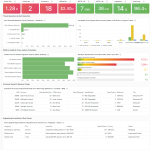
Awishcar’s SaaS Churn Risk Intelligence dashboard unifies billing, CRM, product analytics, and your warehouse into one view that quantifies ARR at risk and explains the drivers behind every move in net revenue retention. It is part of our Operational Intelligence Dashboards.
If you want to see what your own accounts look like when CRM and database churn signals finally sit side by side, book a free walkthrough.
Related reading
Churn is one silent killer. Cost is the other. See The AI Margin Trap (Token vs MRR) for how token costs quietly erode AI gross margin.
Featured photo by Luke Chesser on Unsplash.