



At 10:03 AM, your security console lights up. In minutes, 12,482 raw telemetry events cascade into 2,130 correlated alerts, 184 high-severity detections, and 2 critical incident flags. Tier-1 analysts scramble to work the queue.
Here is the question nobody in leadership can answer for the next 45 minutes: which customers are affected, how much ARR is on the line, and which upcoming renewals are at risk?
That disconnect—between the flood of security alerts and the revenue reality behind them—is the security blind spot. During an active breach or platform attack, it is the most expensive visibility gap in cybersecurity SaaS.
Security consoles count threats. The business runs on revenue.
Modern SIEM and XDR platforms are engineered for threat triage: events per minute, alert severity, anomaly scores, and endpoint telemetry. All critical. All indispensable.
But when an incident escalates, the questions asked by the COO, VP of Customer Success, and Head of Support are fundamentally commercial:
- “Which enterprise customers are experiencing degradation right now?”
- “How much total ARR is exposed across affected tenants?”
- “Are any marquee accounts renewing within the next 30 to 90 days?”
- “Why did Zendesk ticket volume spike by 300%, and how is it tied to the security event?”
In standard security workflows, an alert from an internal test environment looks identical to an active credential-stuffing attack hitting a $480K/year enterprise customer. By the time customer success realizes what happened, the customer is already angry, support queues are overflowing, and the renewal conversation has cratered.
During an incident, the picture shatters across systems
Cybersecurity operations do not live in a single pane of glass. When an attack strikes, the operational context is fractured across disconnected tools:
- SIEM & XDR (Splunk / CrowdStrike / Sentinel): Active threats, compromised tokens, and anomaly logs.
- Platform Telemetry (AWS / Datadog): API latency spikes, 5xx error surges, and Kafka ingestion lag.
- CRM & Revenue (Salesforce / HubSpot / Stripe): Customer plan tier, contract ARR, renewal dates, and assigned CSMs.
- Support & Ticketing (Zendesk / Intercom): Inbound ticket inflow, SLA breaches, and customer sentiment.
- Engineering (Jira / PagerDuty / Slack): Root cause tracking, hotfix deployment, and incident channels.
Each team stares at its own console. Nobody sees the whole board. The incident commander is forced to stitch the pieces together manually in a war room Slack channel while critical minutes tick away.
What a real-time security operations command center looks like
The solution is not another security monitoring dashboard. It is a cross-functional operational command center that correlates threat telemetry directly with platform reliability and customer revenue exposure on a single screen:
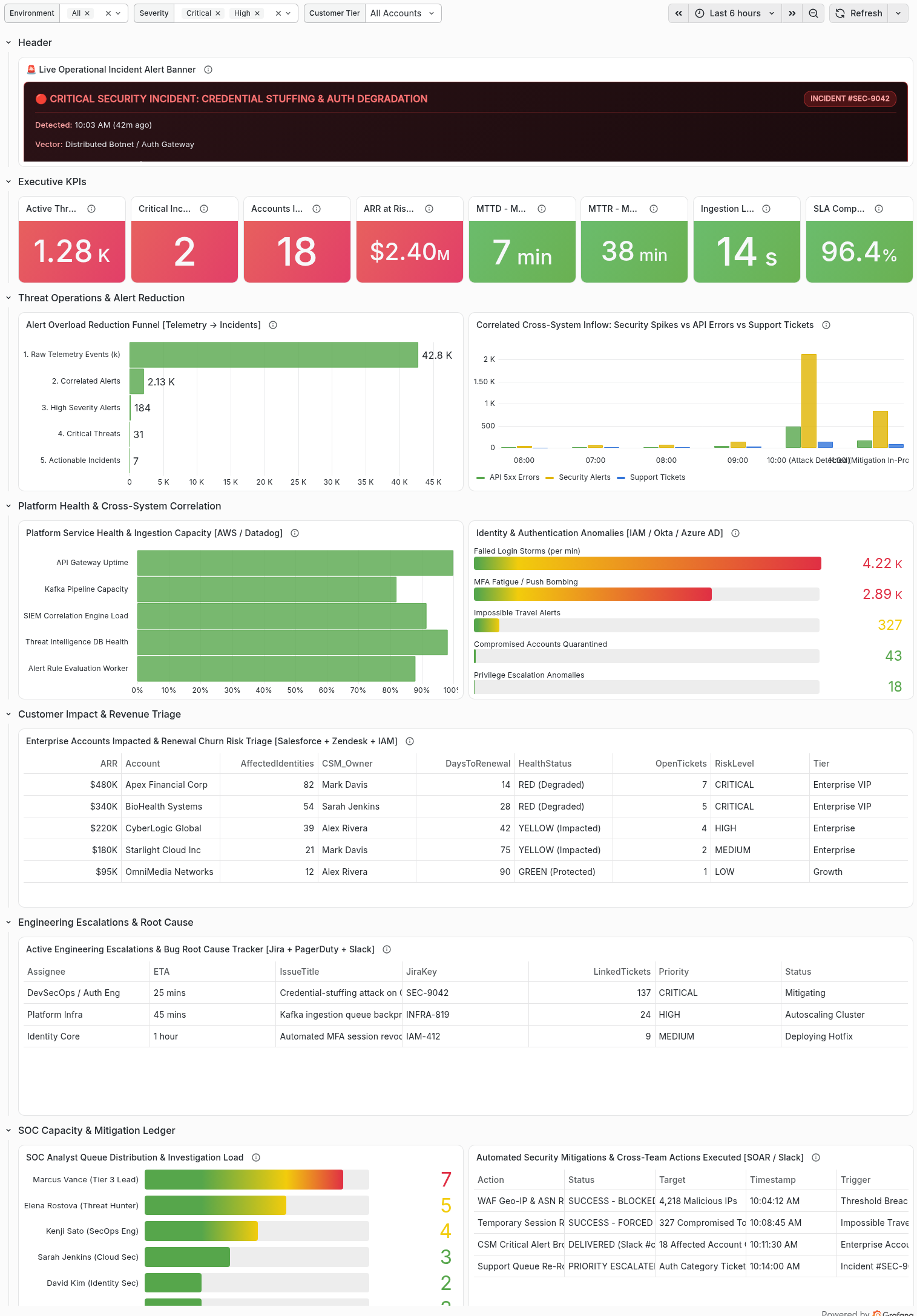
- Live Incident Broadcast Banner: What attack is underway, the root cause, containment ETA, and automated SOAR defense actions executed.
- Executive Operational KPIs: Active threats, critical incidents, affected customer count, ARR at risk ($2.4M), real-time MTTD (7m), MTTR (38m), and SOC SLA compliance (96.4%).
- Alert Overload Reduction Funnel: Visualizing the filtering of 42k+ raw telemetry events down to 7 actionable incidents.
- Correlated Cross-System Timeline: Overlaying attack spikes with platform 5xx errors and Zendesk ticket surges.
- Enterprise Account Impact Ledger: High-value accounts sorted by ARR, renewal countdowns, health score status, and direct CSM outreach triggers.
- SOC Analyst Capacity & Jira Escalations: Real-time investigation load balancing and bug fix ETAs.
Now, within the first 5 minutes of an incident, the entire executive team knows exactly which $2.4M in ARR requires proactive protection and which automated defenses have already succeeded.
From reactive firefighting to operational command
Transforming security operations from a siloed cost center into a business-aligned command post follows four clear principles:
- Correlate immediately. Map every security incident ID to tenant identities and Salesforce account values.
- Triage by business risk. Prioritize containment and communications based on enterprise ARR and renewal windows, not just raw telemetry noise.
- Align Engineering and Support. Spot the platform and support fallout before customer queues breach SLA limits.
- Proactively shield renewals. Arm Customer Success with real-time incident context before affected accounts reach out in frustration.
Connect security alerts to revenue protection
Awishcar’s Real-Time Security Operations Command Center connects Splunk, CrowdStrike, Okta, Datadog, Salesforce, Zendesk, and Jira into a single operational cockpit. It turns chaotic alerts into structured executive clarity.
It is part of our Operational Intelligence Dashboards suite.
If you want to see your security telemetry and enterprise customer risk unified on a single screen, book a free walkthrough.
Related reading
Discover how operational command centers protect customer revenue across SaaS: see The Support Blind Spot (Tickets vs Revenue), The Silent Churn Killer (CRM + DB), and The AI Margin Trap (Token vs MRR).
Featured photo via Awishcar Security Operations.